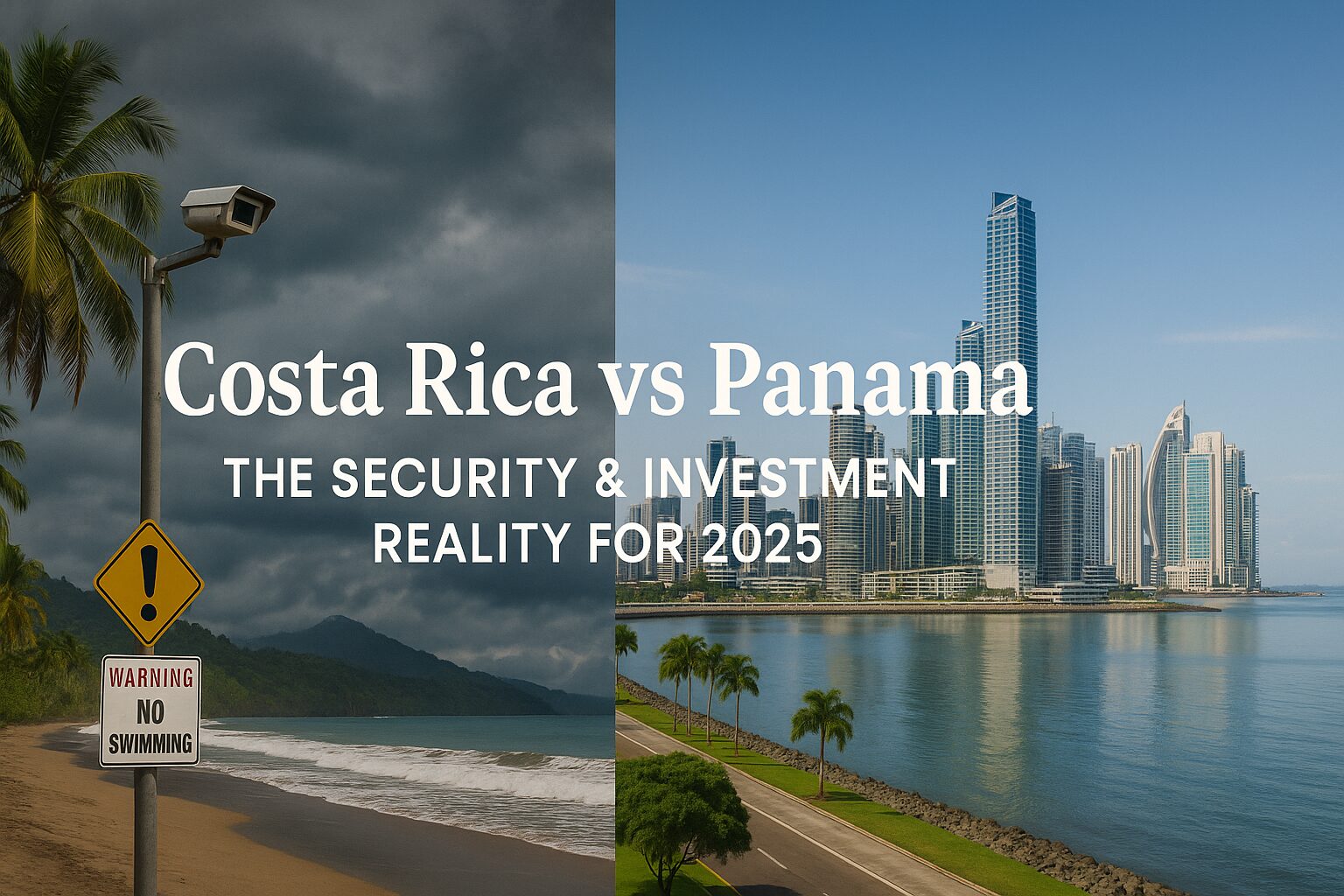
Costa Rica's transformation from Central America's peaceful haven to a nation grappling with record violence is reshaping expat and investor decisions across the region. With 2024 marking the second-worst year for homicides in Costa Rican history—880 deaths at 16.6 per 100,000—the country's appeal as a retirement and investment paradise faces unprecedented challenges. Meanwhile, Panama emerges as the region's safest alternative, offering not only superior security metrics but also unmatched tax advantages and infrastructure that position it as the premier destination for international residents and real estate investors.
The security landscape shift represents more than statistical fluctuations—it reflects fundamental changes in regional drug trafficking patterns, economic pressures, and governance capacity that directly impact the daily lives and investment decisions of the substantial expat communities across Central America. For the thousands of North American and European retirees who chose Costa Rica for its "Pura Vida" lifestyle and democratic stability, current realities demand serious reconsideration of both personal safety and financial strategies.
The numbers tell a stark story of rapid decline. Costa Rica's homicide rate has nearly tripled since 2000, jumping from 6.3 to 16.6 per 100,000 inhabitants. The most dramatic surge occurred between 2022 and 2023, with a staggering 41% increase that shattered all previous records. Even with a slight 3.5% improvement in 2024, the country remains at historically dangerous levels that fundamentally contradict its decades-long reputation as an oasis of peace in a turbulent region.
Tourist-targeted crime has reached crisis proportions, with over 6,300 reported incidents against foreign visitors in 2024 alone. Popular expat destinations bear the brunt of this violence: Jacó recorded 279 incidents, Cahuita 194, and Quepos 151. The Ministry of Security now officially designates 36 high-risk zones specifically affecting tourists, many in areas that traditionally attracted the highest concentrations of foreign residents and investors.
The geographic distribution of violence reveals troubling patterns for the expat community. While 14 rural cantons recorded zero homicides, the coastal provinces that house most international residents show alarming increases. Limón Province leads with 37.8 homicides per 100,000—more than double the national average—while tourist havens like Manuel Antonio, Puerto Viejo, and Jacó consistently rank among the most dangerous areas for foreign visitors.
Drug cartel infiltration drives the escalation. Colombian Clan del Golfo controls southern operations while Mexican Sinaloa and Jalisco New Generation cartels dominate northern territories. Costa Rica's evolution from transit point to logistics hub and growing consumer market has created territorial disputes that generate 70% of the country's homicides. These "settling scores" killings increasingly affect bystanders, with innocent civilian deaths rising from 7 in 2021 to 45 in 2023.
Beyond raw crime statistics, Costa Rica faces interconnected challenges that create an increasingly difficult environment for expats and investors. Economic inequality has reached crisis levels, with a GINI coefficient of 49.2 ranking among the most unequal OECD countries. Youth unemployment at 31.9% provides ready recruitment for criminal organizations, while over 21,000 students dropped out of school in 2024.
The country's infrastructure foundation is cracking under fiscal pressure and deferred maintenance. Road network investment declined 33% between 2015-2023, while police forces remain understaffed by approximately 5,000 officers. With 200 of 900 patrol cars non-operational and officers earning roughly $600 monthly, the government's capacity to address security challenges remains severely constrained.
Tourism industry decline accelerates, with a 13.8% drop in arrivals from September 2024 to March 2025 despite record 2024 numbers. The Costa Rica Tourism Institute's own data shows 62% of U.S. tourists citing safety concerns when choosing alternative destinations. This tourism retreat directly impacts real estate markets, with coastal communities reporting 20% declines in tourism-related employment and corresponding pressure on property values and rental demand.
Currency appreciation adds another layer of difficulty for dollar-earning expats. The colón strengthened from ₡614 per USD in 2022 to ₡512 in 2025, effectively reducing purchasing power by 20% while violent crime simultaneously degrades quality of life. Combined with 5.8% inflation outpacing U.S. rates, the cost-benefit equation that historically favored Costa Rica continues deteriorating.
In stark contrast, Panama maintains Central America's lowest crime index at 42.9 compared to Costa Rica's 53.7, while achieving a homicide rate of 13.0 per 100,000—significantly better than Costa Rica's 16.6 despite sharing many regional challenges. More importantly for expat communities, Panama's violence concentrates in specific areas easily avoided by international residents, while Costa Rica's tourist-targeted crime spreads across popular expat destinations.
Geographic safety advantages strongly favor Panama. High-crime areas like Darién Region and parts of Colón are clearly defined and rarely overlap with expat communities. Established international residential zones like Boquete, El Valle de Antón, and Casco Viejo maintain minimal crime rates with strong security infrastructure. Meanwhile, Costa Rica's 36 designated tourist crime hotspots include major expat centers like Manuel Antonio, Jacó, and Cahuita, making risk avoidance far more challenging.
Government response capacity shows marked differences. Panama deployed over 1,000 additional police officers in 2024 through its "Panama 3.0" security operation, achieving measurable crime reductions in tourist areas. Costa Rica's government, despite hiring 1,500 new officers since 2023, struggles with budget constraints, equipment shortages, and the fundamental challenge of policing drug transit routes that now affect most of the country.
The drug trafficking impact varies significantly between countries. While both serve as transit points for Colombian and Mexican cartels, Panama's stronger institutions and U.S. cooperation agreements provide more effective interdiction capabilities. Panama seized 119 tons of cocaine in 2023 with relatively contained violence, while Costa Rica's 27 tons seized accompanied record homicide levels driven by territorial disputes and revenge killings affecting civilian populations.
While superior safety metrics provide Panama's foundation, the country's territorial tax system creates extraordinary financial advantages unavailable elsewhere in the region. Foreign-sourced income remains completely tax-exempt for Panama residents, potentially saving high-earning expats $35,000-$50,000 annually compared to home country obligations. This zero-tax treatment of international income, combined with no capital gains, inheritance, or wealth taxes, establishes Panama as perhaps the world's most favorable jurisdiction for location-independent professionals and retirees.
Residency programs offer immediate pathways to permanent status with exceptional benefits. The Pensionado program requires just $1,000 monthly pension income but provides 25% airline discounts, 50% entertainment savings, 25% restaurant and hotel reductions, and 15-20% medical service discounts. These benefits alone can offset $3,000-5,000 annually in living expenses while providing immediate permanent residency—a combination unmatched globally.
Infrastructure quality creates practical advantages for daily life and business operations. Panama City's metro system, Tocumen Airport's regional hub status, and seven undersea fiber-optic cables provide connectivity and transportation options unavailable in Costa Rica. The dollarized economy eliminates currency risk while the investment-grade banking sector offers sophisticated financial services supporting international business and investment activities.
Real estate investment conditions strongly favor Panama. Foreigners enjoy identical property rights to nationals with constitutional protections, while established title systems and corporate ownership structures provide tax-efficient investment vehicles. Current market conditions offer properties at 25-50% of equivalent U.S. locations with 6-7% rental yields, supported by growing expat demand and continued infrastructure development.
Healthcare systems provide another competitive advantage. While Costa Rica's CAJA system faces increasing wait times and service pressures, Panama's private healthcare sector includes internationally accredited facilities like Pacifica Salud (Johns Hopkins affiliate) and San Fernando Hospital. Costs remain 25-33% of U.S. equivalents while quality matches international standards, with many English-speaking physicians trained in North America and Europe.
Real estate markets reflect security realities in both countries. Costa Rica's 2024 transactions declined 10% with land sales dropping 42%, while premium pricing increasingly concentrates in gated communities and high-security developments. Investors report growing concerns about isolated properties and coastal areas experiencing the highest crime rates.
Panama's market shows opposite trends, with steady demand for both residential and commercial properties driven by continued expat influx and infrastructure development. The $19.5 billion five-year infrastructure plan supports property values while clear geographic risk boundaries allow investors to avoid problem areas entirely. Boquete, Coronado, and Panama City's established expat zones maintain strong fundamentals with minimal security concerns.
Cost-benefit analysis increasingly favors Panama. While overall living costs run 2-4% higher than Costa Rica, Panama's territorial tax system, Pensionado discounts, and superior infrastructure provide substantially greater value. The elimination of currency risk through dollar adoption, combined with investment-grade banking access and established expat service providers, creates a more stable platform for long-term residence and investment.
Travel advisories from major governments reflect these changing dynamics. Canada upgraded Costa Rica to "high degree of caution" in June 2025, specifically citing rising crime rates and tourism safety concerns. Meanwhile, Panama maintains "normal security precautions" outside clearly defined high-risk areas that don't affect expat communities.
Location selection becomes critical in both countries but offers clearer options in Panama. Costa Rica's widespread tourist crime affects most major expat destinations, requiring constant vigilance and limiting lifestyle choices. Panama's concentrated risk areas allow complete avoidance while maintaining access to established expat communities with full service infrastructure.
For retirees, Panama's Pensionado program provides unmatched global benefits combined with immediate permanent residency. The territorial tax system eliminates taxation of foreign pension income while constitutional property protections and dollar economy provide stability unavailable in Costa Rica's increasingly volatile environment.
Real estate investors should prioritize Panama's clear legal framework and geographic risk boundaries. Properties in established expat zones offer better security, stronger rental demand, and more predictable appreciation patterns than Costa Rica's crime-affected coastal markets. Corporate ownership structures provide tax efficiency while constitutional protections ensure long-term security of investment.
Costa Rica's transformation from peaceful haven to regional security concern represents a fundamental shift that affects every aspect of the expat and investor experience. The convergence of record violence, economic pressures, infrastructure decay, and governance challenges creates an environment where traditional advantages no longer offset mounting risks and costs.
Panama emerges not merely as an alternative but as a superior destination offering enhanced security, exceptional tax benefits, stronger infrastructure, and established expat communities. The combination of territorial taxation, immediate residency pathways, constitutional property protections, and geographic risk management provides a compelling package for international residents and investors.
While Costa Rica may eventually address its security and economic challenges, current trends suggest continued deterioration through 2025-2026. For expats and investors prioritizing safety, tax efficiency, and infrastructure quality, Panama's advantages create a clear choice in an increasingly uncertain regional landscape. The decision becomes not whether to consider alternatives to Costa Rica, but why delay the transition to Panama's superior combination of security, financial benefits, and quality of life.
For expert guidance on Panama relocation, business setup, and investment opportunities, contact us - your trusted partner for Central American business solutions.
Crime Statistics and Security Analysis
Tourism and Economic Impact
Travel Advisories
Panama Tax and Residency Information
Real Estate and Investment
Cost of Living Comparisons
Infrastructure and Governance:
